




















At rock-breaking or concrete-demolition sites, a common judgment often arises in equipment selection discussions: the heavier the hammer and the thicker the chisel, the faster the breaking. This statement may seem valid in some hard-rock conditions, but treating it as a universal rule can easily lead to overlooking striking rhythm, hydraulic supply, and carrier compatibility during procurement. In actual operation, breaking efficiency is jointly determined by the attachment, the carrier, and the material; simply comparing weight or chisel diameter is not enough to judge which hammer is more suitable.
What 'heavier is faster' overlooks
The working process of a hydraulic breaker converts hydraulic energy into kinetic impact of the piston, which is then transmitted to the material through the chisel. A heavier hammer body may increase the single-impact energy, but only if the carrier can provide the corresponding flow and pressure and the structural components can withstand the recoil. If the carrier's hydraulic system supplies insufficient flow, even a heavier hammer body may have a slower or unstable striking rhythm, which in turn affects breaking efficiency. Therefore, weight and chisel diameter are only part of the selection information and cannot be used alone as a basis for judgment.
Another easily overlooked factor is the material condition. Hard granite, basalt, and ordinary concrete have different requirements for impact energy; reinforced concrete also presents situations where rebar cannot be cut and the chisel easily gets stuck. Applying the same 'heavier is faster' logic to different materials often results in a mismatch between the hammer and the site.
Several relevant conditions in the ME450 information
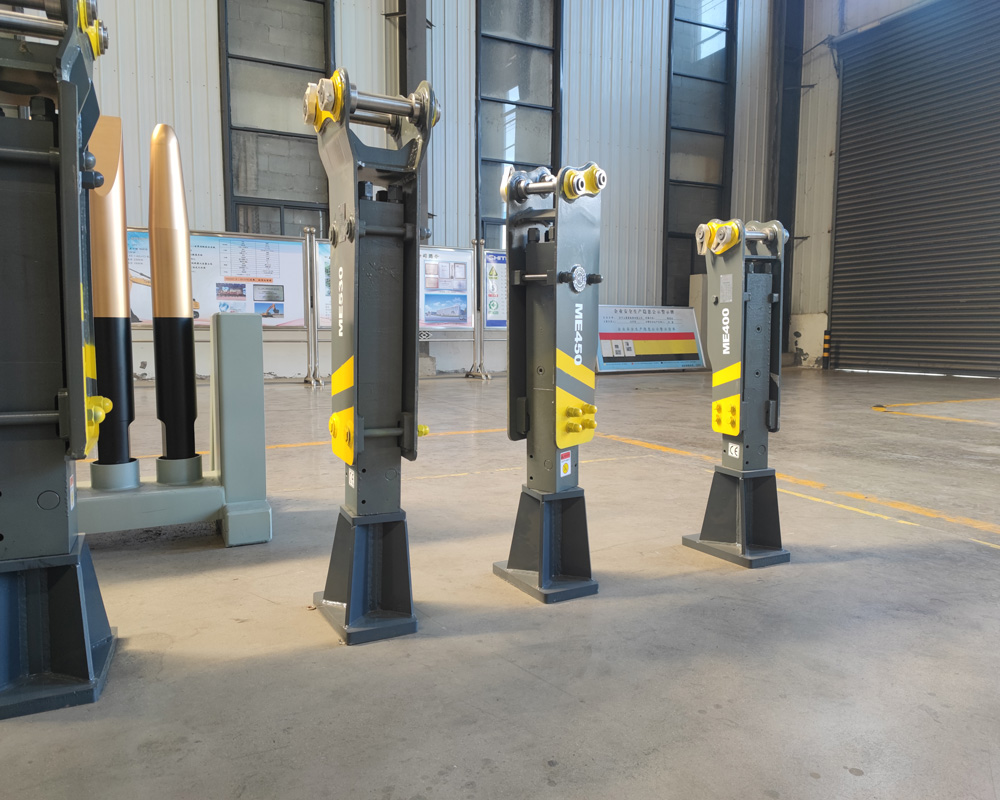
Public information about the ME450 hydraulic breaker from this site shows that the attachment uses a 45 mm heat-treated chisel, weighs approximately 105 kg, is suitable for 2.5 to 4 ton excavators, and has a hydraulic flow range of 20–40 L/min. The information also mentions structures such as an integrated accumulator, a stable internal valve, a high-stability cylinder core, and a vibration-damping thrust support. These details do not point to 'heavier is faster' but to another judgment path: the match between attachment weight, flow range, and carrier capability.

- The 105 kg lightweight design places relatively limited burden on the hydraulic systems of small and medium excavators.
- The 20–40 L/min flow range is the first interval to check when selecting a carrier.
- The 45 mm chisel undergoes multi-stage heat treatment, and the information states that it balances surface hardness and core toughness.
- The integrated accumulator absorbs hydraulic peaks and pulsations and is related to the stability of the striking rhythm.
These features indicate that the ME450 is positioned not to win by weight but to maintain stable impact output under a lightweight premise. For breaking tasks with limited working space, smaller carrier tonnage, or frequent relocation, this trade-off has practical significance.
What conditions jointly determine striking rhythm
The striking rhythm of a breaker is usually affected by hydraulic flow, pressure, accumulator condition, and material feedback. When flow is low, the piston's reciprocating speed is insufficient and the interval between impacts lengthens; when flow is high but pressure is insufficient, impact energy may be inadequate; when the material is too hard or the chisel is stuck, recoil is transmitted back to the hammer body through the chisel, affecting the stability of continuous operation.
The precision internal valve and integrated accumulator mentioned in the ME450 information correspond to two functions: flow management and pulse buffering. The internal valve is responsible for stable flow control within the 20–40 L/min range, while the accumulator absorbs hydraulic peaks in the circuit. Working together, their purpose is to keep the striking rhythm from changing noticeably due to flow fluctuations. However, the premise for this structure to function is that the carrier's hydraulic system itself can provide stable flow and pressure. If the carrier's pumping capacity is insufficient or the pipe diameter is too small, the design on the attachment side cannot compensate alone.
Which work scenarios are more suitable for judgment based on this approach
According to the public information on the ME450, its use scenarios include concrete demolition, rock breaking, sidewalk removal, basement renovation, trench excavation, and confined-space work. The common feature of these scenarios is high requirements for equipment mobility and working space; the breaking volume may not be large, but work points are scattered or space is limited.

In such scenarios, what deserves more attention during selection is whether the carrier can stably provide 20–40 L/min flow, whether the attachment weight is within the carrier's load capacity, and whether the chisel tip type is suitable for the material. If selection is based only on 'heavier is faster,' one may choose an attachment that exceeds the carrier's hydraulic capacity or structural load range, which instead affects continuous operation.
Conditions to verify before purchase
The public information on the ME450 provides basic parameters on the attachment side, but whether the carrier and attachment match still needs to be verified item by item against carrier information and site conditions. The following items are recommended to be clarified before inquiry:
- Whether the carrier's operating weight is within the 2.5 to 4 ton range, which is the applicable interval given in the information.
- Whether the carrier's hydraulic system flow can cover 20–40 L/min and whether the pressure is within the attachment's allowable range.
- The attachment weighs approximately 105 kg; whether the carrier's front-end load capacity and connection dimensions match.
- Whether the work material is mainly concrete, rock, or reinforced concrete, and whether the chisel tip type needs adjustment.
- Whether the working space is limited and whether frequent relocation is needed, which affects the trade-off for a lightweight attachment.
- Continuous operation duration and shift arrangements, which determine considerations for hydraulic oil temperature management and maintenance intervals.
It should be noted that the above parameters come from the public information on the ME450 and cannot be used to infer the performance of other models or products in the same series. The information does not provide specific values for the connection dimensions, hose interfaces, and hydraulic pressure matching between the carrier and attachment, which need to be confirmed in writing with the manufacturer or the carrier side.
Selection boundaries when information is insufficient
If the site is mainly engaged in high-intensity continuous breaking of hard rock, or if the carrier tonnage clearly exceeds the 2.5 to 4 ton range, the ME450 information is insufficient to support a selection judgment, and larger-specification attachments or different carrier solutions need to be checked separately. Conversely, if the work is mainly concrete demolition, trench excavation, and confined-space breaking, and the carrier flow is within the 20–40 L/min range, the ME450's lightweight and flow design are worth including in the comparison.
'Heavier hammers break faster' is not a conclusion that can stand independently of the carrier and material. Before purchase, organizing carrier hydraulic parameters, attachment weight, work material, and site space into a checklist and then confirming each item against the attachment information is closer to actual work requirements than simply comparing weight or chisel diameter.
For inquiries, it is recommended to provide: carrier model and operating weight, hydraulic flow and pressure information, work material type, single continuous operation duration, working space dimensions, shift arrangements, and existing attachment interface conditions. This information helps determine whether the attachment and carrier can form a stable match and also facilitates targeted verification opinions from the manufacturer.