


















When adding a breaker attachment to a mini excavator, the common decision sequence is to look at the hammer specifications first and then work backward to find a carrier that can handle it. But when starting from the job objective, the order is often reversed: first clarify what material is to be broken, how large the working space is, and how long continuous operation will last; then judge whether the carrier's operating weight and hydraulic supply can support the attachment; and only finally settle on a specific model. This site currently does not focus on mini excavators as a news topic. This article uses only the public information on the ME400 hydraulic breaker as a reference to discuss the conditional relationships when pairing compact carriers with breaker attachments, for readers with similar job requirements to check their thinking.
Determine the job objective first, not the hammer
The choice of a breaker attachment must first answer "what to break" and "where to break it." Concrete pavement, indoor demolition, frozen soil, or shallow rock in small quarries place different demands on impact rhythm, chisel type, and working space. When the job objective is unclear, simply comparing hammer weight or chisel diameter can easily lead to discovering only after the attachment is mounted on the carrier that the rhythm does not match or the connection dimensions do not fit.
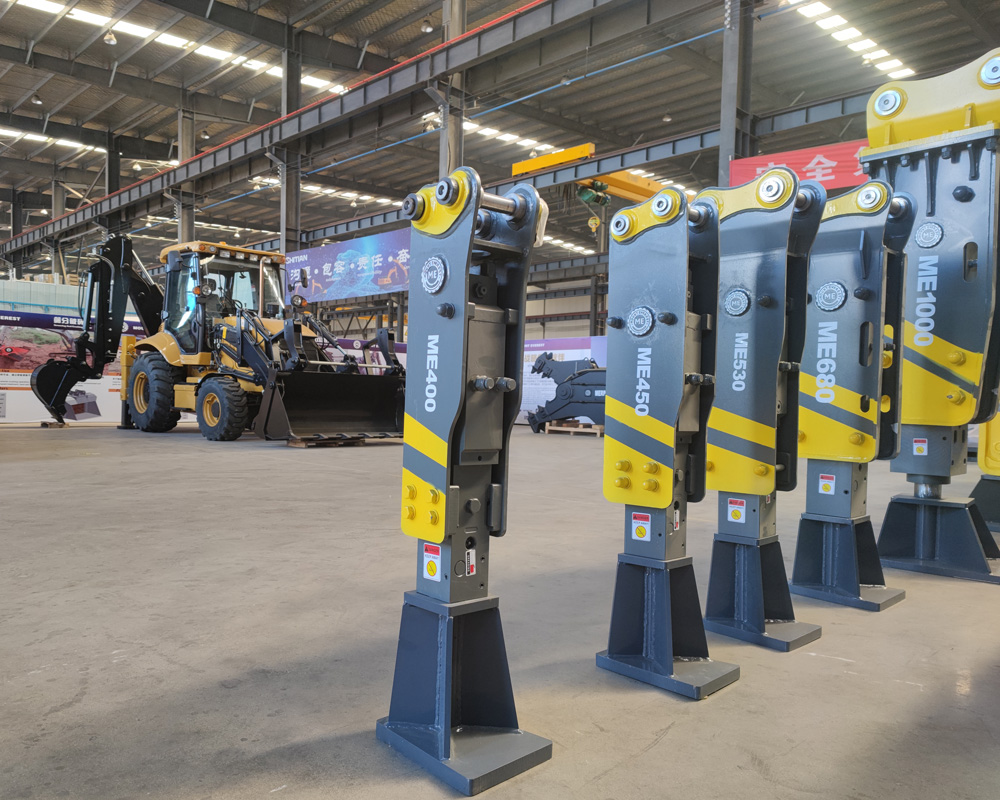
The public information on the ME400 lists its application scenarios as concrete demolition, rock breaking, trenching, and indoor demolition, and states that its compact size suits work in confined spaces. This description corresponds to scenarios with limited working space and small single-point breaking volume, rather than continuous high-load primary crushing in mines. Readers can first use this to judge whether their job objective falls within this range.

Carrier side: operating weight and hydraulic parameters are two basic thresholds
The ME400 documentation gives a matching range of 0.8 to 2.5 tonne mini excavators, an attachment operating weight of 80 kg, and a chisel diameter of 40 mm. Whether the carrier falls within this range is the first screening condition. But operating weight is only the starting point; whether hydraulic flow and working pressure match determines whether the attachment can stably deliver its impact rhythm.
The hydraulic parameters given in the documentation are an oil flow of 15 to 25 L/min and a working pressure of 90 to 120 kgf/cm². Before purchase, the carrier's hydraulic output must be compared with this range to confirm whether flow and pressure remain stably within the range during continuous attachment operation. If the carrier's hydraulic parameters are missing or deviate from the range, matching should not be judged as valid based on the tonnage range alone.

Attachment side: weight, chisel, and interface conditions
An attachment weight of 80 kg is not a negligible load for a compact carrier; it affects the carrier's stability and boom feedback during breaking work. The shock-absorbing structure and reinforced front head mentioned in the documentation correspond to the need for vibration isolation during continuous breaking, but the carrier-side pin connection dimensions and hose interface type are not given in the attachment documentation and must be confirmed in writing with the carrier manufacturer or attachment supplier.
Regarding the chisel, the ME400 offers three tool types: Moil Point, Wedge, and Blunt, and the documentation states that they can be selected according to application requirements. Different tool types correspond to different breaking methods; readers should choose according to material condition and job objective rather than defaulting to one as universally applicable.
Checklist for working backward from job objectives
- Whether the material type and single-point breaking volume fall within scenarios such as concrete demolition, rock breaking, and trenching.
- Whether the carrier operating weight is within the 0.8 to 2.5 tonne range, and whether hydraulic flow and pressure cover 15 to 25 L/min and 90 to 120 kgf/cm².
- Whether the carrier connection dimensions, pin specifications, and hose interfaces match the attachment; written confirmation is required.
- Whether the working space allows normal slewing and travel of the combined attachment and carrier.
- Whether the continuous operation duration and the carrier's hydraulic oil temperature management conditions are adequate.
Application boundaries and items to be confirmed
It should be noted that the above information describes only the parameters and application direction of the attachment itself. Whether the carrier and attachment are directly compatible must be verified item by item based on the carrier's operating weight, hydraulic flow and pressure, attachment weight, connection dimensions, and hose documentation. A carrier compatibility conclusion not given in the documentation cannot be inferred from the tonnage range alone. If the job objective exceeds the scope of concrete demolition, rock breaking, trenching, etc., or if continuous operation intensity is high, the attachment specifications and carrier matching plan should be re-evaluated rather than forcing the existing parameters to fit.
This site currently does not focus on mini excavators, and this article does not constitute a recommendation for complete mini excavator machines. If readers already have a compact carrier and are considering a breaker attachment, it is advisable to provide the material type, working space dimensions, per-shift operating duration, carrier model and hydraulic parameters, and connection dimensions when requesting a quotation, so that the supplier can judge whether the attachment specifications and interface conditions are satisfactory.